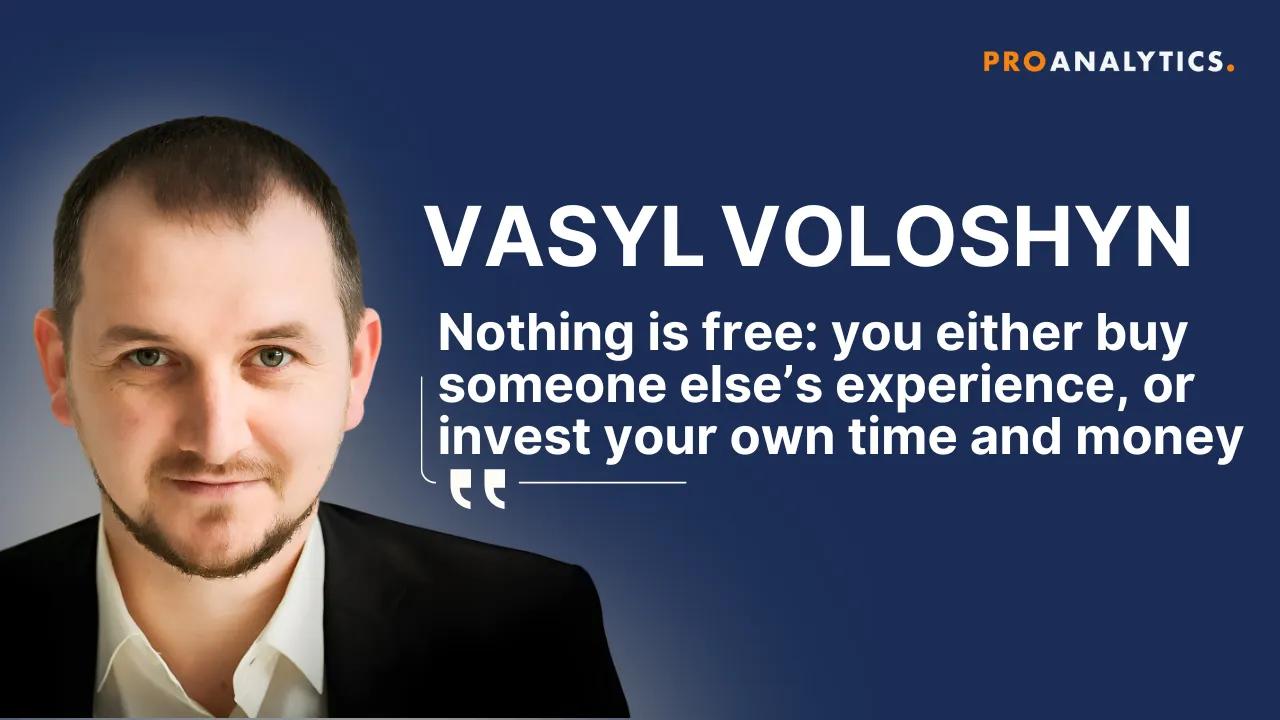
“Nothing comes for free: you either buy someone else’s experience or invest your own time and money”: an interview with Vasyl Voloshyn about business, team development, and screw-ups in PPC

Hello! My name is Maks Hapchuk, founder of PROANALYTICS.ACADEMY. Today I’m talking with Vasyl Voloshyn — a PPC specialist and founder of the marketing agency PPC Rocks, which helps businesses with online advertising, particularly in e-commerce.
From this interview you will learn about:
- Vasyl’s path from working at a factory to running his own agency with 25+ specialists;
- how he motivates the team to keep learning and why he pays bonuses for completed courses;
- the origin of the cheeky name “The Immodest Marketer”;
- screw-ups at work and what they taught him;
- what Merchant Center unblocking is and the “headaches” e-commerce advertisers face;
- advice for business owners: when it’s worth running ads yourself and when to hire professionals.
And much more — so read to the end!
— Let’s go. First classic question — who are you right now?
— Right now I’m the owner of the marketing agency PPC.ROCKS. I already have 25 specialists on the team across different profiles: from Merchant Center unblocking and Facebook ads to paid search, which has the most people working on it.
— You’re an agency owner now, with over 10 years in marketing. How did you get here?
— I’ll start from the beginning. I started by building websites — simple ones in HTML, a bit of CSS. Very minimalist design to make the site as fast as possible. That was back in 2010. I studied HTML, CSS, WordPress, and built my first sites in Notepad++. At first things were fine, but…
Websites without people are of no use to anyone.
So I started learning SEO: downloading courses, reading blogs. Back then, stories were popular about how you could buy an apartment in a few months by selling links through exchanges like Sape. I read, experimented, and began building more serious sites.
Copy-pasting worked well then — I cranked out sites in batches and promoted them. In the end, I had 5 sites left that collectively brought in up to 30,000 users a day. That brought me about €700 a month, and in parallel I worked at a factory.
— What did you do at the factory?
— I was a welding production engineer: filling out forms, chasing welders to stamp parts. Mostly paperwork. Not “in a white suit” like Dima Kolyadenko, of course )
Eventually I’d had enough. I joined the Kharkiv agency Fresh IT on a minimum salary. They had a 3,000 rate on Work.ua, and I said, “Take me for 2, I won’t let you down.” Even though at the factory I was making 8,000.
At the agency they put me on link building. It was the most “unprestigious” job no SEO wanted to do. But coming from the factory, I didn’t know that — and I was happy to do it.
— Why did you decide to look for a job if the website traffic was making money?
— The traffic did bring in money — around €700 as I said — but I wanted to learn not to drive traffic chaotically, rather to do it systematically, like in professional agencies. There you manage several projects at once and analyze commercial traffic. Mine was mostly informational under Google AdSense. So I went to an agency to get that experience.
— And how did a factory engineer get the idea to build websites in the first place?
— I thought about websites back in my fourth year at university. I bought a computer, though I barely knew how to use it. In school, IT was limited to how to turn a computer on and off. The only thing I could do was play Counter-Strike over LAN. But I understood there was money on the internet — you just had to learn how to make it.
I was advised to build websites. Our class monitor said, “You make a site, hang banners — and earn.” I got excited, built my first site, and started waiting for money. None came. I even clicked on the ads myself — and Google blocked my AdSense.
Then I approached it more seriously: created new sites, set up ads to different payment details, and didn’t click myself anymore. I started gaining momentum. The topics varied: women’s, pensions, accounting, law. But gradually they faded: CPC dropped, payouts shrank. And when the Maidan started, it all crashed further: from €700 a month down to €100–80. I lost motivation, but during that time I grew in SEO and became a team lead because senior colleagues left.
— And how did an SEO person decide to become a PPC person?
— Then I moved to another agency — they poached me with a higher salary. But after six months, the client I was hired for dropped off. And the manager said: “Learn paid search.”
PPC was completely different: you launch a campaign quickly — you spend the budget quickly — you see results quickly. It’s not SEO where you have to spend half a year explaining why the site fell from fifth to seventh place and hope the client doesn’t churn.
In SEO we had all kinds of clients. For example, one had his own metric for whether he was “in the top.” He explained it literally like this: “When I’m in the top for respirators — ‘idiots’ call me. When I’m not in the top — they don’t call.” It was hard to work with that.
So PPC hooked me. You can’t fake it here: there are numbers — there are results. The client gives you a month of trust. If there’s at least some improvement — they stay, if not — they leave.
— And how did you learn PPC?
— Through screw-ups [smiles]. I was the only PPC person on the team. They showed me a few things, and then I took courses on my own and experimented in the account. I made especially many mistakes in Google Ads Editor — it’s very easy to mess things up there. But those mistakes taught me to work fast. Sometimes you were given 2 hours for a task, you spent them on screw-ups, and then in 15 minutes you sorted it out correctly.
Back then I came up with a rule: “If it works — don’t touch it.” Often after in-house specialists, campaigns look crooked but they work. You remove a “crutch” — and everything collapses. That’s why we still protect “locomotive” campaigns that drive most sales, and in parallel we launch others. Only when those are ready to pull part of the turnover do we touch the “locomotive.”
But of course, screw-ups still happen today. What was your toughest screw-up?
— What was your toughest screw-up?
— There were a few — I’ll name two.
The first — a client on Prom.ua. All conversions were being imported from their account. I thought, “Why these micro-conversions?” and left only purchase (back then in Google Analytics Universal). And what happened? Sales started to drop: from 2–4 a day to 1–2, and then 1 sale every two days. I went through the settings, did everything “by the book,” but there was no result. Then I remembered the micro-conversions, brought them back — and the project “came to life.” Even a weird conversion like “hover on the phone number” turned out to be important for the algorithm.
The second screw-up — a baby strollers store. At first, over a month I doubled performance, and the season helped too. With a 5,000 UAH budget the client had 125 orders. And against that backdrop I relaxed: the client says “do it” — I do it. He asks for changes again — I do them again. As a result, I started tweaking campaigns twice a day, and the results tanked. The mistake was giving in to impulse: thinking that once you’ve hit good performance, it will hold forever. In reality, the client made me destroy what worked with his own hands.
— And how do you act now when a client demands something?
— If the proposal is logical, we test it. For example: “Let’s test a new traffic type with a 5,000 budget for two weeks.” No problem. But we agree right away that it’s a test and doesn’t count toward the overall results, because a test is always 50/50.
But if a client proposes something inappropriate — like “click our competitors” or “file complaints” — we refuse immediately. Once a client even wrote: “I can pay, remove the competitor.” The next day he apologized himself: “I was drunk.” We don’t do that stuff — for me it’s a matter of karma and reputation.
— Speaking of karma and reputation, what about arbitrage? You tried it too, as far as I know?
— Yes, that was a test for me. For about three months I tried arbitrage on my own at home in the evenings: signed up for CPA networks and drove traffic from teaser networks. In the end I broke even and realized it’s not for me. Because to earn in arbitrage, you have to make peace with your conscience.
It’s mostly gray products there: “weight loss,” goji berries, various “miracle remedies.” Or Power Balance — a bracelet with a magnet that cost $1 and was sold for $20. Its ads were abused everywhere back then: it helps with hangovers, with diseases, you name it. It was absurd. I looked at it and realized: arbitrage is definitely not for me. That’s not work — that’s roulette.
So I decided: no arbitrage. I prefer clean search ads and e-commerce. I’m glad I chose PPC: it’s a transparent space, and we work only with “white” projects — online stores.
— Where did your channel “The Immodest Marketer” come from? Is it related to another channel, “The Modest Marketer”?
— “The Modest Marketer” did come first — the channel existed before I started, but I don’t know the author. I was pushed by a phrase from Yevhen Cherniak: “Why be embarrassed, nobody cares about you anyway.” I was sure I’d deliver content no worse than paid courses — and that’s how “The Immodest Marketer” was born. I started publishing with full dedication.
I remember riding a bus to my parents’ place in Kharkiv oblast: my wife sits down, I’m standing, and on my phone — with a tiny screen — in an hour I typed a long piece about SKAG (one keyword — one ad). I wrote it from memory: what I tested, what hurts in practice. Over years in employment I tried almost every theory in paid search — so the posts “hit.” Then I quit the agency and started building my own.
— What’s your content strategy? Do you write by plan or when something “sets you on fire”?
— If you look at the posting graph — there’s no plan. I really write when I’m “on fire.” Yesterday, for example, in a Google Shopping chat a guy asked: should sizes be on one page or separate pages for each? I answered in the chat, then in five minutes recorded a TikTok and posted it. It’s elementary, but many people burn on it: PPC has its own logic, SEO has its own.
In parallel I release videos about painful bugs — today (meaning at the moment of our conversation), for example, about OpenCart and why users end up in Direct/None. I wrote about this problem in a post four years ago, but even my employees still “get caught” by it from time to time, so I recorded a video.
— Do you edit the videos yourself, or does someone help?
— My wife edits the horizontal videos. And I stopped editing verticals — it’s hell. Even a short TikTok demands tons of stuff: script, a room where the cat isn’t running and meowing, lighting, recording, editing, distribution… It’s an unreal amount of work.
So now we don’t edit vertical videos at all. Earlier a freelancer girl made cool clips with subtitles, but I realized “content made on the knee” works better and faster; besides, there are plenty of questions from employees and chats — there’s no shortage of content ideas.
— You run all this yourself? You have Telegram, YouTube, TikTok… Are you an SMM person? And why is there a meme in every post?
— I’m not an SMM person and never aimed to be one. I combined useful but “dry” content with a meme — so it “goes down with a beer” and lightens the mood. Memes give reach, and then people read, like, comment — a double format like that.
The ppc.rocks page is now run by SMM specialists, while I run my personal profiles myself. Sometimes my wife throws in “silly” ideas — they often grow into something cool. She’s a generator of raw ideas, and I’m the filter.
— So your wife works at ppc.rocks? Can we say you have a family business?
— Yes. At first she helped with paid search, distribution, and video editing. Then I handed accounting to her; editing stayed; she also writes copy for Telegram posts. She’s already picked up my style so it doesn’t sound “like ChatGPT.”
Honestly, I don’t write most of the video thumbnails. I read and approve, sometimes tweak. I write the long “meaty” posts myself, but short intros — more often she does. You could say we have a family business. We prop each other up: she from her side, I from mine. That’s why we don’t fall over.
— You’re active in PPC chats. How do you feel about “competitors”? And do you plan your own courses?
— I don’t have courses and don’t plan to. I give everything away on YouTube. Right now I’m a bit “greedy” with scripts — I write them to make work easier and give them away in exchange for a comment, so I can see who I helped.
I’m not afraid of competition — it raises quality. For me, “competitors” are often colleagues and friends. Many of them become clients or partners because we do not only PPC management but also Merchant Center unblocking — a tricky thing that many are afraid of. Specialists often pass accounts to me for unblocking or buy the service for their client, and the client may not even know about me — all communication goes through them. I’m fine with that: I unblocked — they keep managing.
Sometimes a paid search specialist is afraid of Performance/Shopping — then they recommend me for e-commerce. So the chat isn’t competitors, it’s a network of colleagues who reach out from time to time.
— What is the “Merchant Center unblocking” service and how does it work?
— Merchant Center is a Google service through which product data is uploaded for advertising. It gets blocked often, and then products don’t show. There are many reasons. You can get blocked at any moment: at the start, or in a year or two when they review your site and what exactly you’re advertising.
Do you know that specialists hate unblocking Merchant Center, Google Ads, writing to support, and so on? Nobody wants to deal with it. That’s where we help. I’ve even indirectly built an unblocking department. I explained to the girls what to do and check, helped them learn. First I took unblocking off our internal specialists’ plates, and then the service went public. Now a whole department focuses only on this: pass advertiser verification, unblock Merchant Center and Google Ads.
— What are the three most common, non-obvious reasons for blocks you encounter?
— First — copying information from big sites like Rozetka or Comfy. Google “forgives” them a lot more, but not small stores. And also simple carelessness. Most often the problem is on the “Delivery,” “Payment,” “Returns” pages. Imagine: you sell underwear, but in your policies it says “we don’t accept returns on soldering irons.” You don’t even sell soldering irons, but because of such mismatch Merchant Center blocks the account.
The second reason — lack of specifics about delivery. Owners often write one sentence: “delivery across Ukraine” — and that’s it. But for Merchant Center that’s not enough. It should specify whether there’s courier delivery, what it costs, and the conditions. If that isn’t stated, the risk of a block is very high.
And third — online payment. Many think: “The store works in search — so Shopping will be fine too.” But no: Merchant Center requires online payment — LiqPay, Portmone, and other services. If there’s no online payment, a block lands immediately.
— As I understand it, Merchant Center and Shopping are your main focus? Give three tips to a PPC specialist: what to watch at the start with an e-commerce project.
— There are three quick checks. If they’re okay, the campaign should work. If one of these points isn’t in order — you definitely need to stop and sort it out, because it will only get worse.
First — analytics. If it’s set up properly, you can work. If it’s absent or set up crookedly — nothing good will come from the ads.
Second — price. If a store is unknown, people choose purely by price. And there’s often a problem here: a client comes in with prices higher than Rozetka’s. Rozetka has a brand and trust, so they can afford to sell higher. But if a small, unknown store sets a price twice as high, there won’t be sales.
For example, we had a case with an “astronaut lamp”: it cost 400 UAH on Rozetka, and 1,200 at the client’s. Same product, same size, batteries, color. How are you going to sell it at triple the price? So there’s no way around it — either you undercut at the start or nobody buys from you.
— But from what you’re saying, it turns out a small business survives only by undercutting?
— At first — yes. Because when a store is unknown, people choose by price. But over time, as the brand and trust form, the situation changes. We have a client — the one whose analytics you audited, by the way. Their prices are even higher than competitors’, but the brand is already recognized, and we keep ROAS over 1000%. It works thanks to brand trust. So at the start you must compete on price, and later — on brand.
And the third point: it’s not the ads that sell — it’s the website. Ads bring traffic, but if the site is built poorly, there will be no conversions. Often it’s made by some acquaintance programmer or a neighbor, and then they wonder why it doesn’t sell.
A common mistake is checking the site on desktop. But that’s no longer the main thing. You need to test on mobile, because most people come from their phones: on the bus, in the subway, wherever. And you need to see how the user journey works across devices — iOS, Android, etc.
And one more thing — the budget. For example, we have a 200,000 budget, and if you set strategies like “maximize conversion value” or “maximize conversions,” Google will calmly “eat” all of it. But I don’t like that approach. I set higher budgets on campaigns than I’m actually ready to spend, and then control with target CPA or target ROAS. The campaign may not spend the entire budget while delivering higher efficiency. For instance, the same 200,000 can bring 1M in revenue at 500% ROAS, or 1.4M at 700% ROAS.
If an ad isn’t spending the full budget, it means it’s already working at its maximum capacity.
— Continuing on advice: Google is now actively pushing Enhanced Conversions. Do you use them in your work?
— Yes, we do. But I’ll say right away: it’s not some magic button that instantly changes results. They just add more data for campaign learning, and because of that optimization becomes a bit better. Google itself says the approximate uplift is about 4%.
On small volumes, this is barely noticeable: if you have 10 conversions, 4% is just noise. But when it comes to large-scale projects with 2–3 thousand conversions a month, those 4% turn into 100–120 extra conversions. And here it becomes significant. So my position is simple: you definitely should set it up, it won’t hurt for sure.
By the way, in our agency everyone learns how to set up Enhanced Conversions in a course from PROANALYTICS.ACADEMY. I personally took this course too. Honestly, at first I thought: well, it’s half an hour of work. But Eugenia, the course author, dug so deep I hadn’t even imagined such nuances. In the end, I completely underestimated the course and was pleasantly surprised. It’s really very cool.
— Constant growth and team learning are very important. How does it all work for you?
— All specialists take courses voluntarily, and for this they get extra bonuses on top of salary. In general, pay is fixed + bonuses, and one of those is specifically for courses. The principle is simple: a small course — a small bonus, a big course — a bigger bonus. If an employee completes a course and passes the “exam,” they start receiving that bonus every month. On average, it can add 20–25% to the salary in total for all courses.
All our courses can be divided into internal and external. Internal — those I personally recorded and posted in a closed channel. External — primarily from PROANALYTICS.ACADEMY; everything related to advanced analytics we fully cover with your courses.
— How does the exam work? Who conducts it?
— In most cases I do. The format depends on the course. To avoid spoiling internal processes I’ll focus on your courses as an example. If it’s GA4 Basics — a few simple questions for 15 minutes are enough. I took this course myself, so I know what’s important for PPC to ask.
The Enhanced Conversions course, for example, “passes automatically.” A specialist must independently, without the team lead’s help, set up Enhanced Conversions via Google Tag Manager on a real project. Then the team lead checks, and if everything works correctly — the course is credited.
But courses like PRO GTM or PRO ANALYTICS are more advanced: you really need to work with the setups, so the exam takes more time and is even more practical.
— So my courses cost you a lot: you buy the courses, and then still pay bonuses?
— On the contrary, it’s a profitable investment. Because I save the most valuable thing — my own time and the time of team leads. If an employee has taken a course, they don’t ask me basic questions. This removes routine and allows everyone to work more efficiently. Instead of explaining the same thing again and again, I can say: “Check that course — everything’s broken down there.” It’s much simpler and more effective.
— In our conversation you talk a lot about numbers and calculate them in your head very quickly. I also like to calculate in my head, but my profession is analytics, it’s all numbers. You’re a PPC guy, but your math is no worse. Where does this skill come from?
— It’s from my childhood. I grew up in a village in Kharkiv oblast, near the Izium highway. In the 90s everyone survived as they could: people sold potatoes, apples, whatever. I also picked apples in the garden and sold them on the roadside. That’s where my “math” began — I had to calculate quickly in my head.
At school I was an A student in math. Even though I had eyesight problems, often couldn’t see what I was writing in the notebook, in my head I solved tasks faster than half the class. Since then I got used to it, and today in any situation I quickly calculate numbers.
And for me it’s a matter of principle. Because if you don’t understand the numbers and take people’s word for it, it’s very easy to get tricked. But when you can quickly calculate yourself, no one can “pull the wool over your eyes.” Numbers are my strong point, and thanks to this neither specialists nor clients can fool me.
— Do you use math in training your specialists?
— Yes. I have an internal course for employees: first block — 0–2 months, then 3–6 and 6–12. I quickly recorded a video series for the closed channel, explaining what exactly they need to know at each stage.
And there I have a favorite “trick” for newbies. I give them a task: the client has a 20% markup, ROAS is now 1000%, budget — 100,000 UAH. With every additional 10,000 UAH of budget, ROAS drops by 10%. The question is: what is the maximum budget that can be spent so that ROAS does not fall below 900%, and what net profit will the client receive in both scenarios?
Almost every beginner “fails” this task. They even try running it through ChatGPT, but it also gets confused. And the solution is this:
Scenario 1: budget 100,000 UAH
- With ROAS at 1000%, every hryvnia invested returns tenfold revenue. This means that a budget of 100,000 generates a turnover of 1,000,000 UAH.
- Given a 20% margin, the client receives 200,000 UAH in gross profit.
- After subtracting the initial ad budget (100,000 UAH), the net profit is 100,000 UAH.
Scenario 2: budget 200,000 UAH
- When the budget increases to 200,000 UAH, ROAS decreases to 900%, meaning each UAH of budget now returns only ninefold revenue. This generates a turnover of 1,800,000 UAH.
- With the same 20% margin, the gross profit amounts to 360,000 UAH.
- After subtracting the ad spend, the net profit is 160,000 UAH.
So when expenses grow, ROAS decreases, but net profit still increases. And this is a very important logic for beginners: don’t look only at ROAS, but understand the real benefit for the business.
— I like the topic of training, but I also have another question I was curious about before we started: where did the name PPC.ROCKS come from? Who came up with it — you, friends? How did it appear?
— Actually, I didn’t come up with it. I had a friend I worked with in an agency. When the .rocks domain zone opened, he registered PPC.ROCKS — he planned to run a blog as a PPC specialist. Over time he moved into management (I think at a Polish agency) and realized PPC.ROCKS wasn’t for him anymore. He thought about selling the domain but then decided to give it to “his own” — and offered it to me.
I looked and thought: “PPC.ROCKS — sounds cool.” I paid him symbolically — around $100–200 — and the domain was transferred to me. The name really drives me. I didn’t want to name the company after my surname — that ties you as the “face,” which is risky. And here — a strong separate name that lives on its own.
The logo was drawn by a designer colleague: I’ve been keeping it for 5 years, no plans to change. The “two fingers up” story also came from me: I wanted the last “finger” higher — a symbol of growth. At first the logo was made mirrored, I asked to flip it. In the end, PPC.ROCKS wasn’t my idea, but I hope this domain lives with me to the end — I’ll only keep developing it.
— Development also means growth. How do you hire new PPC specialists to your team?
I look for people like myself and don’t hunt for “stars.”
— Stars are very hard to retrain. If a person has spent years “scratching their left ear with their right hand,” re-educating them takes more effort than training a beginner from scratch. That’s why I have an internal course where all the main points are written out.
The very first task is to get familiar with the interfaces. I ask them to go through Google Analytics, Google Ads, Search Console, Tag Manager, Clarity, and the client’s website. Click around everywhere, don’t save anything, just get used to where things are. Because if a task or problem comes up, they’ll already know where to go.
The second task is working with checklists. Every step has to be screenshotted in Google Docs and described. But not copied from my video — it must be done in their own interface: if I show an example in Google Analytics, the specialist must repeat the same actions in their own account, with their own client. This is important: when you write things down yourself or take screenshots, the information sticks much better.
As a result, the checklist isn’t for me — it’s for the specialist themselves. It’s their own base they can rely on anytime. And most importantly, I don’t train to sell courses externally. I train people exclusively for the agency’s needs. And it works: nobody complains that the system is too complex or impractical.
— And what’s next? What skills and tasks does a specialist go through in training? Rephrasing: what should a PPC specialist be able to do at each stage of development, in your opinion?
— Well, for example, at the 3–6 month stage a specialist should be able to:
- connect GTM on Shopify,
- segment ad campaigns,
- work with geo-targeting,
- start using Google Ads Editor (earlier I forbid it, because critical mistakes can be made).
Also, somewhere around here, e-commerce tracking is set up for the first time.
From 7 to 12 months, more complex tasks are added:
- tracking form submissions of any complexity,
- setting up free call-tracking with number substitution in GTM (by the way, the last two points are taught in your PRO GTM course),
- working with Merchant Center (raising limits, fixing feeds, resolving disapproved products).
This is also when more complex scenarios are tested — for example, launching a hundred campaigns through Editor. At this level, the specialist confidently automates routine processes and works with technical details.
— What processes do you automate in the agency to reduce routine for specialists?
— We automate a lot, because doing everything manually is exhausting.
First — reporting. We have scripts that weekly and monthly gather data from Google Ads and Facebook. This saves a ton of time: instead of building tables by hand, everything’s already ready.
Second — product monitoring. I made a script that every 4–6 hours checks the feed and shows what happened: price increase, product disappeared, new product appeared. Often a client changes prices without warning, and we’re already spending budget.
Third — a bot for Merchant Center blocks. If it gets banned, often Google Ads gets blocked “by attachment” too. So the bot checks the account status every 10 minutes. As soon as it sees a critical error, it instantly signals the specialist. This gives time to quickly break the link and save the account.
Fourth — reports on disapproved products. Every week the client receives a list of disapproved items with reasons. If we can solve the issue ourselves, we fix it. If not — we pass it to the client.
And probably my favorite thing — the “Rat” script. It collects all changes in the account every week and shows which email they came from. If the changes are from the client — I explain why that’s not allowed. If they’re all ours — the project is under control. It also helps manage the team: sometimes a specialist makes one change a week, and then the client asks: “What am I paying for?” And then I open the report — and everything is clear.
And one more important point — Google Ads Editor, but only in experienced hands. On one hand, it speeds up work 3–10 times: I personally launched a hundred campaigns in 10 minutes. But on the other hand — if the specialist doesn’t know what they’re doing, they can break so much that it takes ages to fix. It can be a screw-up multiplied by 10.
Overall, these automations save a massive amount of time for specialists, project managers, and me. Less routine — more opportunities to focus on strategy and project development.
— Who writes the scripts for you — yourself, a hired developer, or ChatGPT?
— I work with a freelancer. I don’t write code myself. Before we worked with one guy — he was slower, now I hired a stronger one, and things improved. The biggest pain was reporting: clients often don’t open or understand Looker Studio. So we made a short, clear report: costs, number of orders/sales, total sales amount, average check, ROAS. 4–5 metrics — and all to the point. Convenient for both weekly and monthly use.
— What’s a “good report” for you from a PPC specialist to a client?
— Minimum metrics, maximum meaning. I use 4–5 key indicators and always cross-check them in two systems — ad account + Google Analytics. You can’t trust one tool: Google “writes” one way, Facebook another, Analytics another.
Of course, CRM is the ultimate truth, but we don’t build very deep CRM reports for everyone. So to assess the situation, 4–5 basic indicators are enough.
If you spent 10,000 UAH on ads and got exactly 10,000 UAH worth of orders, then no matter how beautiful a report you draw, the client’s pocket is still empty.
I always focus on two main metrics: ROAS (when it’s calculated correctly) and revenue. A high ROAS without revenue is a problem. A large revenue with zero profitability is also a problem. These metrics must be evaluated together, and then you look at margin or markup in a specific business.
— Do you work with CRM data? Do you train campaigns on it?
— We do go into CRM, but we don’t build detailed reports for everyone. For some clients we calculate everything monthly in Google Docs. For example, there’s a clothing store: ads haven’t broken even yet, but in CRM we see 300K turnover and 45–50% rejected orders. You need to understand that after an order is placed, the sales zone begins: someone didn’t confirm prepayment, someone gave a wrong number, someone changed their mind. Ads brought the traffic; after that, it’s the sales department’s responsibility.
As for campaign training — we don’t use CRM data. In my opinion, it’s ineffective: managers can “lose” a warm client, and the algorithm will get a false signal. We choose the lesser evil: it’s better to take more conversions from Google Analytics or Ads, even if there’s some “noise.” The more data, the more stable the learning.
Google works with percentages: if there are 100 conversions, it takes roughly 10 signals; if 200 — already 20. So it’s better to give the system a larger sample than to restrict it to only “clean” CRM sales.
Of course, we filter out fakes so they don’t get into training. Plus in analytics we set value limits: for example, if the average order is 5,000 UAH, then everything above 10,000 just doesn’t get passed. Because there have been cases where conversions for millions and billions “slipped through.” This way we protect both ourselves and the client.
— What’s your attitude toward UTM tags?
— UTM tags are a must. If I see a campaign without a tag, I scold the specialist very harshly. My rule: UTM must be on every campaign, and names must be in English, with underscores, no spaces, no special characters. Why is this important? Because then we insert the campaign name into utm_campaign, and in CRM it’s clear which campaign brought the highest-quality orders. If this isn’t there, everything ends up under “Google CPC” or “Ads traffic” — and that’s just like shooting in the dark.
— And now finish the sentence: A PPC specialist who can’t quickly tag campaigns with UTMs through Editor is…?
— An intern. [laughs] Because Editor is a completely different world. Through it, in 15 minutes you can audit an account, download all stats, launch a hundred campaigns, or perform mass actions. And even if the interface hangs or the internet drops — Editor saves you. But at the same time — it’s also a risk: a screw-up in Editor multiplies by ten. That’s why I always say: Editor is the PPC specialist’s magic wand.
— Where do you think the PPC market is headed? A few weeks ago, Stanislav Galandzovskyi told me “Classic PPC is already dead”. What do you think?
— I think PPC is like SEO: it’s been “buried” for years, but it never dies. Specialists just have to adapt: automation, new tools, AI. For example, recently I built a chatbot assistant: you insert a category URL, and based on prices, discounts, filters, and AIDA/4U formulas, it generates ads. Not perfect, but it saves 1–2 hours of work. That’s exactly how we gradually evolve.
But you need to understand: PPC isn’t about “you enter and money rains down.” It’s work that requires time, learning, and experience. I’ve seen it all. There was a 17-year-old guy who begged me “teach me PPC.” But before that, he was already setting up ads for clients on Prom.ua at 2,000 UAH per account — and never even asked what the results were. That’s the market’s problem: cheap “PPC people” who do sloppy work, and then clients think all PPC specialists are charlatans.
Real specialists survive, because with experience you understand you can’t dump prices and work “for a bowl of soup.” Those who can’t handle it either go back to the factory — where I came from — or try to scam in other niches.
— What advice would you give to people considering getting into PPC: who should, and who shouldn’t?
— First, it’s not about quick money. In PPC you don’t come in and suddenly “cash rains down.” Like in any other job — you need time and understanding. If you work at a factory and just reading case studies gives you a headache, maybe it’s not for you. But if reading and watching examples excites you — then you can try.
From interesting observations — accountants struggle in PPC. From my stats, it’s hard to teach them paid search; at some level they may drop out, and overall results are weak.
Where to start? Most importantly — don’t quit your job right away. Start with small projects for friends “for a review” or symbolic money. Then — ideally an agency for 2–3 years. That’s where you grow incredibly fast: knowledge sharing between teams, support, training. On freelance there’s often no one to ask, and that slows development.
Important point: in PPC false starts happen often. Newbies already think after half a year or a year that they “know it all,” but when it comes to complex tasks — the “logarithms and integrals” of PPC — it turns out the foundation isn’t strong enough. On freelance you’re: PPC specialist, accountant, sales rep, project manager, content manager, and every role the client squeezes from you. Plus you can’t just get sick. It’s one thing alone, another in an agency where someone can back you up.
So my advice is simple: to start, optimally work with projects for three years in an agency, then if you want you can go solo or in-house. Two years is still too little, and half a year or a year — that’s a false start.
— Nowadays many people don’t even have the energy to look up, but you’re growing and developing. Where do you get the energy for all your activities during the full-scale war? What drives you?
— Of course, the war drains energy. After the news it’s hard to concentrate, so I only read it in the evening: quickly scroll through and that’s it. I keep energy through sports: every morning I do 50 push-ups, lift small dumbbells. It’s my mini-routine that gives me a feeling everything will be fine. Another tool — a little notebook with tasks. I write down 3–6 tasks per day: English, help with a project, Zoom call, something for the agency. That’s my route for the day. If someone intrudes with off-plan tasks, I can get annoyed, but overall it works.
I haven’t had a vacation in four years. Maximum — pool, sauna, steam bath for a few hours. Pulling me out of processes for a week is unreal right now. So I want to automate everything enough so that I’m not the only cog the whole machine depends on — but we’re not there yet.
— To wrap up, I’d like to hear a few tips for business owners and others hiring PPC specialists. Do PPC tips depend on business size? And if “yes” — at what stage is it better to choose a freelancer, an agency, or do it yourself?
— Yes, advice depends. If it’s a small business or you’re just starting with a small budget, I recommend finding an agency or freelancer with a relevant case. For example, if I have cases in cosmetics — that means I already have a tested workflow and can get results faster in that niche. Doing it yourself is also possible, but then you save money at the cost of your own time and risk burning budget while learning. Experience with competitors in such projects is an advantage, not a disadvantage.
The first two months are the hardest. It’s like a bike with square wheels: algorithms are just learning, stats are “noisy,” lots of randomness. Here it’s better to hand the project to professionals. Later you can build a hybrid: your own specialist plus backup from an agency or freelancer. If the business is very small, you can go by video tutorials. I’ve recorded over 250 videos about Google Ads, Analytics, Merchant Center myself. But honestly — often it’s cheaper to pay a specialist than to learn on a burned budget. Either you buy someone else’s experience, or you invest your own time and money. There’s no such thing as free setup — your time costs something too.
— And finally: are guarantees and precise forecasts possible in PPC?
— In the first month I don’t give any guarantees. Every specialist before you set things up in their own way, and when we start cleaning up illogical stuff in the account, results may temporarily drop. Not because we’re bad, but because we’re removing chaos. So the first month — no forecasts or guarantees.
Starting from the second month — you can talk about 10–20% growth. The start is always tough: especially when Merchant Center has just passed moderation, the budget is a conditional 10K, and the client asks: “Why aren’t we in profit right away?” It doesn’t work like that. One month isn’t enough. The campaign needs time to learn, and you adjust strategy in the second–third month.
But not everyone understands this. There have been funny cases. One client logged into his ads and placed orders in his own name to “help the algorithm learn faster.” In reality this only confuses the system.
That’s why we always warn: clients or their managers must not place orders from their own ads. It messes with the algorithms.
To sum up, guarantees in PPC can exist — but only when you’ve been with a project long-term.
— Vasyl, thank you for this conversation, it turned out very insightful and useful!
If you still have questions — ask them in the comments.
This is not the only interview on the blog. Previous ones can be found below:
Loading comments…