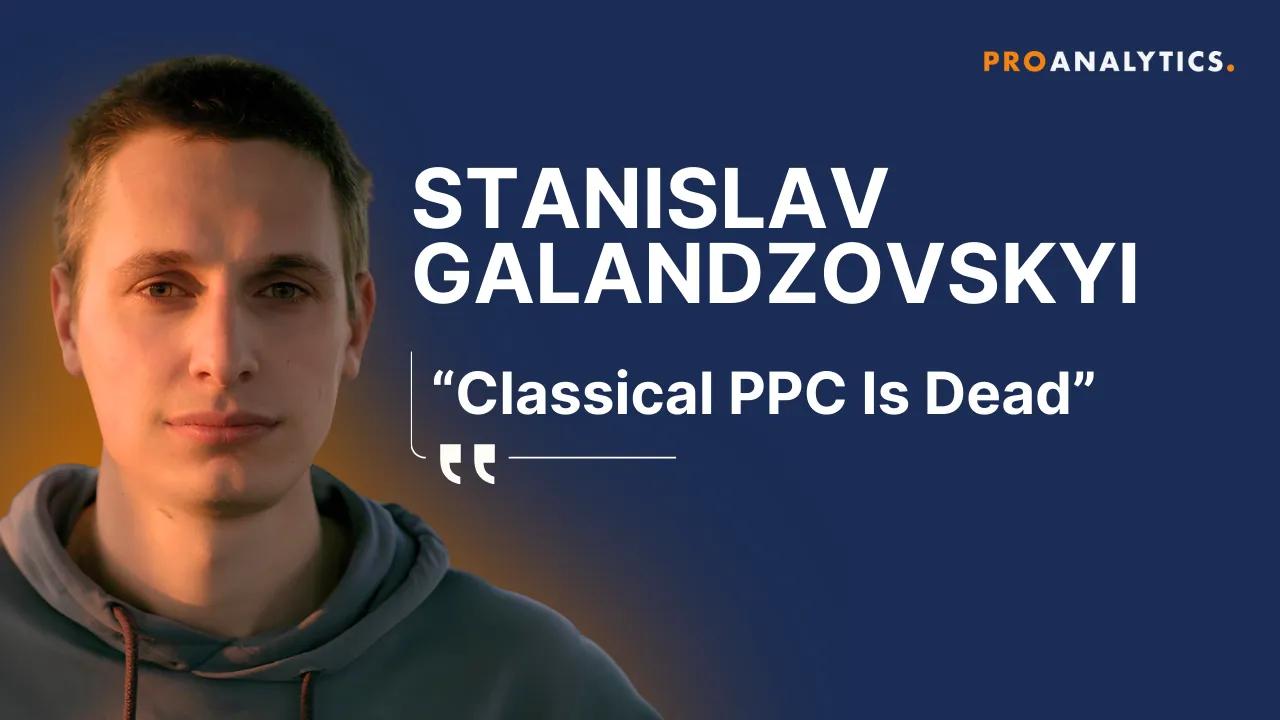
“Classical PPC Is Dead”: An Interview with Stanislav Galandzovskyi on Marketing, Teams, and Analytics

Hello! My name is Maks Hapchuk, founder of PROANALYTICS.ACADEMY. Today I’ll be talking with Stanislav Galandzovskyi — a PPC expert and growth consultant who specializes in Fintech projects.
From this interview, you will learn about:
- the journey from setting up ads “for my brother” to consulting in Fintech for “unicorns”;
- the modern challenges of the PPC profession and why classical PPC is “dead”;
- what makes Fintech difficult, compliance issues, and where the money “flows”;
- why Upwork no longer brings results and how LinkedIn is taking its place;
- how Stas built his own team and why he fundamentally doesn’t call it an agency;
- the role of analytics in marketing and how skills at the intersection of technical and business thinking help you stay a step ahead;
- advice for beginners who want to enter the field: where to start, whether it’s worth going into agencies, and what stages of growth to go through;
- how AI, including ChatGPT, as well as knowledge of SQL and BigQuery, come in handy for a modern marketer;
- what motivates him to keep moving forward every day and not stop at what has already been achieved.
It’s going to be interesting, so read to the end!
— Hi, Stas! My first question is quite simple. Many people know you as a PPC specialist, but lately you’ve been writing on more global and strategic topics. Who are you now, and how do you position yourself?
— Stas Galandzovskyi: [pause] In short — I don’t want to be just a PPC guy. Why? Because when you call yourself a PPC specialist, you automatically devalue yourself. On the market, a classical PPC specialist is worth nothing right now. That’s why at the moment I’m basically working as Head of Marketing in one company, although officially it hasn’t been announced yet. In the public space I call myself a User Acquisition and Growth consultant. My main hard skill, as it was, is paid traffic and user acquisition. But I no longer “sell” myself as just an executor of ad campaigns. When I work with projects — I come in as a consultant: I work with their in-house team, if they have one, or I myself cover issues of paid advertising strategy, creatives, and so on — depending on the needs.
By the way, why specifically consultant? Because the word “agency” in the West is like the plague. Once I was at a conference by the company NAGA (where I worked as Head of Acquisition). And those who came up and said: “We are a marketing agency, we’ll bring you traffic,” — immediately caused prejudice. Nobody wanted to talk to them. But when you position yourself as a consultant, the attitude is completely different. That’s why right now on LinkedIn I’m listed as an acquisition and growth consultant in Fintech. The use of the word growth is now so broad that you can fit almost anything in marketing under it.
— Recently you often mention Fintech. Why did you decide to focus specifically on this field? Because of the money, or because there’s less work? How did you get there?
— I got into Fintech by accident: once I ended up in the startup NAGA (at the time it was about cryptocurrency). At the same time, I handled many freelance projects and gradually figured out Fintech. Then I also moved into other areas of fintech, for example, I worked in the British unicorn Zilch (a Buy Now Pay Later service in the banking segment). Step by step I gained expertise in Fintech and even some recognition in that circle. That’s the first reason why I “settled” here.
And the second reason — they pay more [laughs]. And the competition is lower, because Fintech is difficult. Let me explain in more detail.
Firstly, it’s difficult from the perspective of understanding the business. You need to dive very deeply, for example, into Forex: what broker models exist, how they work, how they make money. And if we’re talking about Fintech in general, then there are even more nuances and variations.
Secondly, there are countless compliance problems (regulatory requirements). We’re not talking about “black hat” traffic methods, but even about basics: which words you can use in advertising and which you can’t. At this stage, many advertisers simply “drown.”
In Fintech no one talks to you in terms of “what ad campaigns will you launch.” The conversation is different: what business problems you will solve with marketing. In e-commerce, when they hire a PPC specialist, they usually ask: “What campaigns will you set up? How many leads will there be?” In the places where I work at the CMO level, nobody even needs access to ad accounts — different tasks altogether. A completely different level of communication.
And thirdly, as I already said, there’s really more money here and less competition precisely because of the complexity. Not every PPC specialist is ready to climb in here, because you need to go far beyond the ad account — deal with analytics, communicate with other departments or developers. And in fintech there’s no other way. That’s why those who can dive in are few — and they’re worth their weight in gold. And they’re paid accordingly. For context: if you rank niches by the level of money, the most money circulates in gambling (as they say, the house always wins), but fintech isn’t much further down. Unlike SaaS, e-commerce, B2B, lead generation, local business… Accordingly, I chose a niche closer to the top of this “pyramid” [smiles].
— I looked at your profile on Upwork: over 5,400 hours there and a listed rate of $100 for 30 minutes of consulting. Roughly, Upwork brought you around $400,000. You used to position yourself as a “Go-to Upwork” specialist, but now I see you’re spending more time on articles and your personal brand on LinkedIn.
— What happened — did Upwork stop working, or did you just outgrow it?
— I’ve been working on Western markets since 2018 — the UK, partly Europe, the USA. And as painful as it sounds, Ukrainian PPC specialists are not needed there. There are many reasons. Programmers from Ukraine are hired willingly because their skill is easy to verify: either you can code or not. But in marketing you need to know the local context, feel the audience — and here ours often lag behind.
Inside Ukraine, you can easily gain some recognition: you actively run Facebook, argue under professional posts, hang out in Telegram chats, speak at conferences, get to know everyone — and boom, people already know you and start inviting you to projects. In the West, it doesn’t work that way. If you decided to enter foreign markets, there are basically two paths:
- Upwork – the simplest option to start with Western clients. It’s a kind of marketplace of last resort: when a company has already asked everyone they know and hasn’t found a specialist, they go to Upwork to look for someone from Eastern Europe with not-so-perfect English whom they can pay little. I believe Upwork is a normal entry point to get some practice and experience with foreign clients.
- LinkedIn – to build a personal brand, show your expertise, and thus find projects. The path is harder and longer, but it gives you a different level of clients in the long run. Step by step I gradually moved to this model: I write articles, share experiences, people begin to recognize me in the Fintech community. That’s how clients come.
As for Upwork: it still works, but not like 5 years ago. Earlier it was almost free: you sent an application — and that’s it. My profile once got boosted so much that I was receiving 7–8 project invites per week and could “passively” close 4–5 clients a month. But now Upwork has made entry paid: you buy “Connects” (kind of “credits” to apply for projects). Accordingly, it became harder to start — you need to invest money, time, analyze everything: how you wrote the proposal, whether they opened it… Algorithms change like in SEO, you have to adapt.
But to say that Upwork is dead — you can’t. The question is how much you want to earn and how systematically you’re ready to work. If you give it your all, then even now in a few years you can realistically reach $10k a month. And that’s very good — it’s almost impossible to find a job in Ukraine for that amount. The maximum I was offered was $8,500 for a CMO position, and that was a one-time case. So Upwork can still give an excellent income.
It’s just that the entry threshold has risen: now, to get a contract, you spend about $100–200 on those same Connects. For an experienced team or mini-agency, that’s normal, but for a beginner freelancer it’s already quite expensive. Many complain about it. My approach: think in terms of ROI. Even a beginner usually has some savings. You can lower your rate to $25 and apply for smaller projects — then the application costs will be lower. Get 1–2 first reviews, gradually raise your rate… Clients are there. There are those who will pay $1,500 or $2,000 a month. If you spent $300 to get a contract, and the client brings $2,000 (minus 12% Upwork fee) and works with you for half a year — that’s an excellent ROI! Before, applications were almost free, now you have to pay — that’s what people don’t like. But the game is worth the candle.
— So in your opinion, beginners can still go to Upwork, and LinkedIn is the next level?
— Absolutely. I’d recommend combining both. Upwork will give you your first projects, an understanding of how to work with foreign clients, and cases for your CV. And at the same time, you need to build your personal brand on LinkedIn. Because if you plan to go beyond small freelance gigs, you can’t do it without a reputation. Right now LinkedIn gives a big opportunity to stand out: there’s a lot of organic reach, it’s easy to grow an audience if you create useful content. I see it with myself: I started writing regularly — the feedback is just crazy. And most importantly — the right people notice you. Sooner or later one of those 5,000 contacts will write: “Hi, I saw your posts, we have problem X right now, let’s discuss consulting.” And that’s it, the client is in your pocket. Clients of that level won’t even appear on Upwork — they’d rather reach out directly to known names. So both tools have their place.
— Listen, how did it all start? Just a few years ago you worked for yourself, now you have a whole team. I know you started from setting up ads for your brother. Then you became a freelancer. And now you’re basically leading your own team.
— What influenced that? What was your “push” at each stage: first — to try PPC, second — to earn a living from it, and third — to build your own team?
— [laughs] The thirst for money. Only that! What else could it be?
Seriously, it all started quite prosaically. My brother and I decided to make our own project — a site “Work in Poland.” We thought, we’ll just put up a site and clients will come on their own. Yeah right… Clients didn’t appear, so we had to look for ways to attract them. That’s how I found out about SEO and PPC. It quickly became clear that SEO takes a long time, but PPC is fast. So I started running ad campaigns. The first results were very encouraging: with a budget of 700 UAH (≈ $30 at the time) we got 6 clients, each paid $200. So we spent $30, earned $1,200, net profit $1,170. ROI was simply cosmic! In 2016 this was possible — ads cost pennies, competition was low. Now it sounds like a fairy tale, but back then it was really very easy to make money on advertising your own product. Unfortunately, after around 2019 this ended, the market matured.
Realizing I could earn from this, I went further into freelancing. I found some beginner marketplace where I managed to get clients and gain practice. Then came other platforms, and finally I reached Upwork.
The next step — a team. Like many freelancers, I can’t say I was dreaming of my own agency, but gradually everything was leading to that. At first I hired one person to help. Then another. Then a third contractor. Then I had to fire someone… Hired again. That’s how we grew little by little. The team began to grow seriously around the end of 2022, when I decided to delegate a significant part of the work. I openly told clients: I’m no longer working alone, we have a small team. And you know, it works really well. Clients react normally. When you say: “We’re not an agency, we’re a small team of several specialists” — everyone is fine with it.
— That’s a trend right now: everyone wants to work with a “team.” By the way, on our site proanalytics.team we specifically crossed out the word “agency” and wrote “team.” And it’s not only about everyone wanting a team for themselves, but also about the perception of cooperation inside.
It’s like when I worked at Silpo, there visitors of the store in internal conversations are called “guests.” And it strongly affects the employees, because to poorly serve a visitor might sound okay to someone. But not to help a “guest” — for many it’s psychologically hard even to say, let alone do.
— That’s the only way it works now. I specifically don’t invent a name for a business, don’t write in my profile “Founder” or “CEO Agency.” Because that’s an immediate minus for karma. I don’t have infrastructure, an office, a sales department to call myself an agency. And I don’t want to. I don’t grab every project I see. I need a limited number of clients. As I say, 10 people should generate $100,000 per month. That is, we focus on a small number of clients, but with large budgets.
People buy people. And nobody wants to work with a no-name agency. Even if that agency shows logos of top clients on their website (Capital, eToro, FXPro — doesn’t matter). It’s still easier for a client to go to a specific specialist or consultant everyone talks about than to a faceless company. When you say “I’m Stas, I have a team, here’s my experience” — it inspires more trust than any agency brand name. If you do grow to the level of a large agency, then it’s a different game: you need your own strong brand, marketing, reputation. Such agencies exist, but they’re rare. For most, in my opinion, it’s enough to build up your personal name and simply have a few helpers. That’s the path I see for myself.
— When we arranged this interview, you said the phrase that “PPC specialists are a useless rudiment.” Explain what you meant. Why do you think classical PPC is dead?
— A classical PPC specialist is a person who works only in Google Ads or Facebook Ads and can’t even set up analytics through Google Tag Manager. Five years ago that was enough: you could know one tool and live just fine. But today that’s not enough. In fact, the role of the PPC guy has evolved into an acquisition manager. You need to know Google, Facebook, and other traffic sources, understand analytics, be able to explain a technical task to a developer, and then analyze the results. And not only your campaigns, but overall how different channels work, what competitors are doing, how user behavior is changing, etc.
”A marketer without analytics is like shooting blind.” Without data you’re just burning budget without understanding what’s happening. And it’s not only about conversion tracking.
I recently had a case: the project was barely breaking even. Facebook and Google were showing great numbers, but the business wasn’t making money. It turned out there were a bunch of sales that weren’t being tracked by standard methods (part of the traffic came through partner networks, part — repeat purchases, others — offline). We built analytics in BigQuery, pulled all the scattered data there — only after that did we see the real picture and understood how to get into profit. And here’s your answer to why the old approach “set up ads — optimize” doesn’t work.
Unfortunately, many people still come out of courses as “classical PPC”: I know the buttons in the interface, I don’t touch anything else. But that doesn’t fly anymore. You need to understand how your actions affect the business. For example, you might order a bunch of creatives just because you want to test something. But you have to calculate: how much does the production of these creatives cost, and will it even pay off? I had a case: in one company they were making a lot of UGC video content in-house, spending tons of time and money, and no one thought to check the unit economics of those specific creatives. Of course, a PPC guy might say “that’s not my business, I just launch ads, not do production.” But a successful PPC specialist in 2025 won’t say that. He thinks wider.
To sum up: classical PPC is already dead. If you want to be effective — develop new skills or lose the competition. A PPC specialist today has to be a bit of an analyst, a bit of a programmer (well, not really), and quite a strategist-businessman. Then he’s valuable. Otherwise, the replaceability of such a “button clicker” is very high, and young and hungry ones will come take his place.
— Agreed. By the way, about analytics and “a bit of a programmer.” How deeply do you think a PPC specialist needs to dive into the technical part? Now everyone is talking about AI.
— I see you yourself are actively using ChatGPT. And then there’s SQL, BigQuery… Does a marketer really need to know all that?
— I’ll put it this way: at a basic level — yes, in depth — no. Let me explain from my own example. I’ve always been interested in this, I simply like it. Once I even thought about going into data science: calculated something there, figured out how many years it would take to study, start as a junior at $400 and in 5–7 years grow to a senior at $7,000… and changed my mind [laughs]. But I did master the basics of analytics, because it’s a must-have for a modern marketer. Another question is how deep those basics go.
Let’s break it into levels.
If you’re a freelancer or working in an agency, a mass-market level of analytics is enough. Meaning what’s given in basic Google Tag Manager or Google Analytics courses. Understand the principles, have an idea of the possibilities. You don’t need to be able to write complex code yourself or set everything up from scratch — but you must know where and what to tweak. Buttons in GA4, basic events, e-commerce… Sometimes you connect a plugin — and it seems to work, but the plugin breaks and data stops coming in. Then you need to fix it manually. So writing custom JS scripts every day isn’t necessary for PPC, but knowing such things exist is useful. By the way, it’s easier now than before: if you don’t know something, ChatGPT will tell you and even generate code. Need to send 10 events to Google Analytics — no problem, it will draft them, and you just adapt it for yourself.
I myself recently set up about 40 events: went into our proanalytics.academy community, they gave me a couple of tips on how to do it better, then I asked GPT, and in a couple of minutes I had a template. In short, AI speeds up routine work many times, if you know what to ask and can verify the result. Before, I’d go ask an analyst for help, and he’d do everything in 10 minutes, and now in those same 10 minutes I get an answer from ChatGPT.
If we’re talking about apps, then a PPC specialist needs to know what MMP systems are (like Adjust, AppsFlyer), how install attribution works. Again, not to build it yourself, but to check the developers’ work — that’s your job.
And if you’ve already grown into in-house, become a Senior PPC or Head of Acquisition, then there’s no way without SQL. You need to have at least a basic understanding and access to BigQuery or to Snowflake/Databricks — so that at any moment you can pull the data you need from the database yourself. Say I’m interested in something about a user cohort — I don’t wait until the analyst is free, I quickly make the selection myself (or with the help of GPT). It saves a ton of time.
Python, JavaScript — a plus, but not required. Honestly, typical PPC guys don’t really need these languages in their daily work. Unless they decide to fully switch careers into analytics.
— You’re one of two people who bought all the PROANALYTICS.ACADEMY courses that have been released. Why do you need that?
— For me it’s important to keep my finger on the pulse. That’s why I buy different courses, even if I don’t plan to use some tools daily [smiles]. Courses are a way to structure knowledge. Back in 2019, I took your first PRO GTM course. Before that, I learned from manuals, watched free YouTube videos, read Google materials. But only when I took the course — everything in my head finally came together systematically. That’s very valuable.
Then I went on to other courses on web analytics, and now to Server-side (though I haven’t watched it yet — in my fintech projects, server GTM was set up by an analyst). Why do I buy them? Because:
- Firstly, analytics interests me, I love figuring it out.
- Secondly, access to content: if I need, say, BigQuery or something new — I know where to rewatch a lesson or ask.
- Thirdly, the community: you can always get advice. As I already mentioned, when I had questions about event setup, people in the community immediately helped me. That’s great.
And one more bonus: if I’m looking for someone to join the team, I’ll be more likely to hire someone who has taken your course. Because I can teach them PPC specifics, but that “certificate” already shows the basics and discipline. It signals that a person invests in themselves, finishes what they start, has structured thinking. So study, study, and study again, as they say.
— You’ve worked in-house (in companies), as a freelancer, and even collaborated with agencies. What would you advise beginners who just want to enter the field, or those thinking of changing their format of work?
— Never start with freelancing if you don’t have experience. That’s the worst thing you can do at the start of your career, honestly. I say this as someone who started from freelancing and knows how hard it is without background. A freelancer at the beginning is a marketer, and their own manager, and sales, and support. Very heavy workload, you can quickly burn out (I don’t like those words) or get stuck at low rates.
I advise going to work in an agency, preferably a big tough “galley” like some large Ukrainian agencies. They’ll squeeze you like a lemon there, but in one year you’ll learn what would have taken five years on your own. I’m not joking. On flow-based projects, under strong team leads, you’ll have to learn every day — and that gives huge growth. Ideally, one and a half to two years working hard in an aggressive agency environment, to grab all possible skills, try dozens of different projects, niches, tools. That will be your foundation.
Then you can think about something smaller — move to a boutique agency or go in-house to some product. But in-house has a nuance: it’s easy to get stuck in comfort. I’ve had people on projects from in-house who were making 4–5 thousand euros, everything seemed fine, but in fact they had turned into such “functionality”: sitting in their narrow area, and didn’t understand basic things outside their responsibilities anymore. The market runs ahead, new features appear, but the person doesn’t know because their company doesn’t deal with it. And then a problem comes, and the only solution they can offer is “let’s relaunch the campaign with a new creative.” Because their imagination doesn’t go beyond creatives. That’s the trouble of many in-house marketers without diverse experience.
So I think going in-house is better after agency work or active freelancing. Yes, in a product there’s more money and stability, but growth depends on the project. If you land in a simple niche — you’ll quickly fall into stagnation. If you land in complex niches (fintech, crypto) — there will be challenges, competition, large budgets, complex processes, new markets. There you can keep growing, even for a lifetime.
And parallel learning hasn’t been canceled. There are so many opportunities now: courses, communities, mentors… As I already said, it gives a structural base that sometimes you lack even if you have a lot of practice.
— Where do you get the energy for all these moves? What drives you?
— Maks, it’s hard to believe, but I’m driven by money. And lots of money [laughs]. Especially when you live in Europe, with a Ukrainian passport, two kids — you start thinking pragmatically. I have financial goals, I have a family, and that’s the simplest motivation: if I work — there’s a result, if I stop working — there isn’t. If I’m tired, that’s not a reason to stop. The only valid reason not to work is when you’re sick in bed. Everything else is excuses.
Of course, there are also ambitions. Career component. Recently I got an offer to become CMO at one broker, but I chose differently — to join a small startup, where I’m the tenth employee in the company, but 6 people there came from Revolut (including the former VP of Growth). Getting access to such people is priceless experience and connections. Plus the product is interesting, at a scale-up level, and it doesn’t prevent me from simultaneously building my own team and leading clients. So I chased not the corporate position or money, but the opportunity to learn and do something new. Because if you sit your whole life only in your sandbox — you can burn out.
Honestly, my motivation definitely isn’t from the pompous series “I want to change the world for the better.” The world changes every second without me [smiles]. For me, it’s simpler and more mercantile. I want to provide for my family, work on interesting projects, and reach new heights. And then, who knows, maybe something useful for the world will come out of all that.
— Finally, I’d like a few recommendations from you:
What would you recommend to CMOs who are looking for a PPC or User Acquisition manager? How to choose, what to ask, how to evaluate a person?
What would you recommend to business owners who see PPC as an investment tool but don’t understand when and how to expect returns?
— It all depends on the budget. If you’re a CMO in Fintech and adequate, then the question of paying 4–8 thousand for a strong specialist shouldn’t even arise. You need to take a verified one from the market and not skimp.
Another question, if the project doesn’t have money yet — then interviews. For example, at NAGA, when I couldn’t afford an expensive specialist, I always asked: “What would you do in such and such situation?” And what mattered to me wasn’t just the technical answer, but also the strategic one — how it would affect the result, what the next step would be.
You need to see how a person thinks, how they reach a decision, where they get information. Because a PPC guy can’t be checked as easily as a programmer. That’s why the right questions in interviews are key.
As for business owners, the best solution is to hire a small team of 5–10 people and not play in-house. The owner of a small team always has personal responsibility (I know from myself): if the project doesn’t work, he’ll replace the PPC guy or climb into the account himself, because it’s his money and reputation.
Small teams for small businesses are great. There’s double control: both the specialist and the owner. In large businesses with dozens of people in the marketing department, an agency can also be useful, but that’s another story.
With freelancers it’s harder. There are few adequate ones, most don’t develop. And without tough self-learning, freelance is a dead end. So for business owners, it’s optimal to work with small agencies.
— And really the last thing: because people who know this story wouldn’t forgive me if I didn’t ask. What about those two competitors from the post? How did it end? Do you work with competitors?
Of course, I work with competitors. And they know it. Moreover — they’re often even happy about it.
On the market, clients have two main requests.
- First, that you have super relevant experience.
- And second, that you don’t work with competitors.
And how does that match?
It doesn’t. The main thing is to know how to explain it to the client. For example, with prop firms I worked over 2–3 years with 7 different ones, now with four. And it’s all similar: same analytics templates, same audiences, copy-paste structures. It’s a market framework.
I always say honestly: yes, I work with other prop firms. And clients reply “we’re okay with it, your experience is what matters to us.” That’s the Western approach. In Ukraine, thinking is the opposite.
Loading comments…